
The Camera as Passport
A photographer and workshop leader on why the experience always comes first

I was a shy kid with a stutter. Social situations that came easily to other children required from me a kind of effort that was exhausting and, more often than not, humiliating. What saved me — what gave me a way through the world — was my father’s camera.
It started with the neighborhoods our family would visit on weekends. Once I convinced my father that I could be trusted with it, something shifted. I did not have to submit to the strict rules of the Catholic schools I attended. I did not have to ask anyone’s permission. All I had to do was load film into the camera, walk through the streets, and make images. There was something incredibly empowering about the entire process. And the fact that it would result in a physical print — that the world I had moved through would become something I could hold in my hand — made the whole thing feel like magic. That feeling never left me.
As I grew older and began to explore on my own, the camera was always with me. Visits to different parts of the country and eventually other parts of the world were never merely an excuse to practice a hobby or document where I had been. The camera was a passport. It fed my curiosity — not only about places, but about people and culture. A sincere smile and a gesture with the camera were both an introduction and a request. When that request was accepted, I was granted entry into someone else’s life for a moment. Without a camera, I would never have been bold enough to start a conversation with a perfect stranger. With it, I had a superpower.
What I took away from those encounters was never just a satisfying photograph. It was the memory of the conversation, the connection, the quality of the light, and the specific feeling of that moment. The photographs were mementos of lived experience, not photographic trophies.
My career as a workshop leader has expanded on this in ways I could never have imagined as a child fumbling with a borrowed camera. The relationships I have built with coordinators who share this same set of values — who understand and embrace the idea that the experience comes first, that education and destination are both in service of something larger — have been among the most rewarding of my professional life. The lesson, the location, the technique: these are stepping stones toward a greater goal. That goal is immersion. It is the willingness to enter a place and a culture different from your own and come away with an appreciation and understanding you did not have before you arrived.
I have always thought it a genuine loss to travel far from home, spend real money, and return with photographs that document what you saw but not what it felt like to be there. The images serve as evidence of presence without the experience. That, to me, is the real missed opportunity — not the blurry frames or the missed exposures, but the unlived moments behind them.
Now, in the early days of what I am generously calling semi-retirement, I find myself more eager than ever to explore — both on my own and alongside other photographers who are chasing the same thing. Not the perfect image, but the full encounter.
X-Pedition Hanoi — October 24 to November 1, 2026
Which brings me to Hanoi.
I am leading a workshop this fall with f8 Photographic Workshops, an organization with deep roots in an immersive, experience-first approach to photography education. For years, these workshops were led by David Hobby — the Strobist — and the philosophy he helped establish there is one I recognize and share: that the photograph is the record of an experience, and the experience comes first. The team at f8 has the years of experience and infrastructure to make that possible in ways that are difficult to achieve on your own.
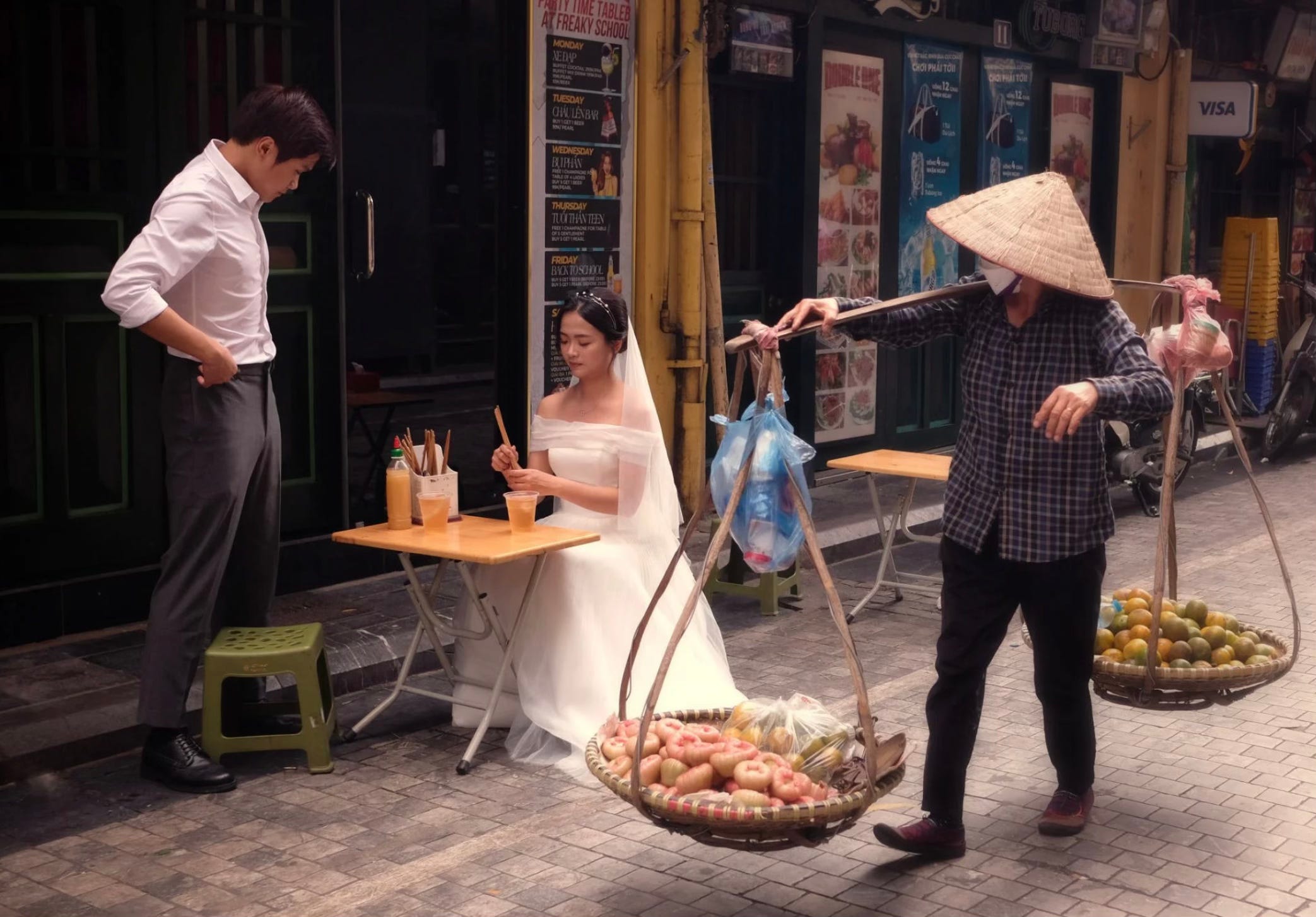
Hanoi is one of those cities that rewards the photographer who is willing to slow down. Its neighborhoods, markets, lakesides, and streets are alive with the kind of unguarded, unhurried human activity that has become increasingly rare in a world that knows it is being photographed. The city has not yet learned to perform for the camera, and that quality — that sense of life being lived rather than displayed — is precisely what makes it so compelling.
The workshop will be based in Hanoi, with time spent in Tam Coc, a landscape of misty limestone karsts and river rice paddies that offers a stark contrast to the capital’s urban energy. Along the way, we will visit a rural village where drums have been crafted by hand for generations, photograph wood-fired pottery and traditional rice paper making, and move through the city during the golden hours when the light and the streets come fully alive. Mornings will begin with group editing sessions — a chance to review what we made the day before and understand not just what worked but why.
Our local producer, Thu Lê Hoài, a lifelong Hanoi resident and experienced fixer for professional photographers and videographers, will serve as our producer and be with us throughout. She knows this city the way a native knows it — not as a series of locations but as a living place — and her presence will open doors that would otherwise remain closed.
What I hope each participant takes home is not a set of photographs that prove they were in Vietnam. It is the memory of having genuinely been there — of having looked carefully, connected honestly, and made images that carry the weight of real experience. That is what the camera has always been for me. A passport. An introduction. A reason to be present.
I would be glad to have you join me.
Learn more and reserve your spot →
photo: David Hobby/X-Peditions
What a wonderful image. I can imagine a workshop experience as you describe would be unforgettable, with priorities in the right place.
I love the idea of a camera giving you a reason to be in the world. A way to really pay attention. I have always thought that. It’s never just a tool. It feels more like an introduction. A way in.
And that line about a physical print being proof that the world you moved through was real… that really stuck with me. Especially now, when so much of what we see doesn’t carry that same weight.